




PVC Warning Tape plays an important role in defining safe and restricted areas. Applied to floors, pillars, pipelines, and wall corners, it uses colors and lines to communicate clear messages to everyone passing by: this is a walkway, that is a restricted area; this route is accessible, while that area requires caution or restricted access.
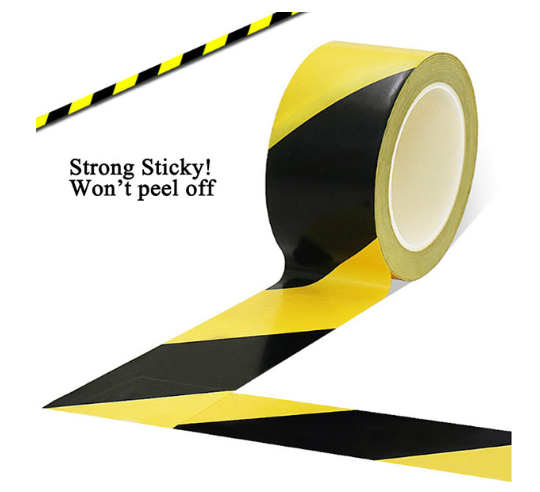
If electrical insulation tape serves as an “invisible line of defense,” then PVC Warning Tape represents “visible order.”
It Is More Than Just Tape Applied to the Floor
PVC Warning Tape is often categorized as floor marking tape or identification tape. However, this classification does not fully reflect the technical requirements behind the product.
Although it shares the basic material structure of PVC backing and rubber-based pressure-sensitive adhesive with electrical insulation tape, its performance priorities are quite different.
For electrical insulation tape, key performance indicators include dielectric strength and flame resistance. For warning tape, the critical factors are peel adhesion, tensile strength, and abrasion resistance.
The tape must withstand pedestrian traffic, vehicle movement, equipment friction, and intensive cleaning. It also needs to remain securely attached to surfaces such as concrete, ceramic tiles, and epoxy flooring without premature edge lifting, cracking, or significant color fading.
A reliable roll of warning tape is essentially the physical carrier of a durable visual information system. Its colors are not merely decorative. They communicate safety messages that may be defined by applicable standards and workplace safety procedures.
Color Is a Language: The Compliance Logic Behind Warning Tape
In industrial and public environments, warning tape colors should be selected in accordance with applicable safety color standards and workplace regulations.
In China, GB 2893-2020, Safety Colours, and GB 2894-2021, Safety Signs and Guidelines for the Use, establish requirements and guidance for safety colors and signs.
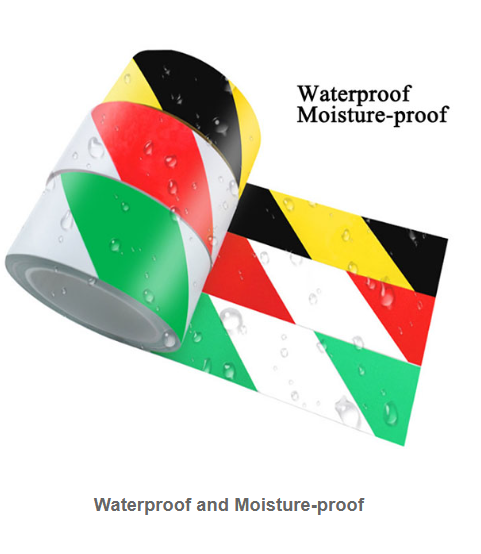
Yellow communicates warning and caution, commonly paired with black to improve visual contrast. Yellow-and-black patterns are frequently used around hazardous work areas, equipment zones, and walkway boundaries.
Red communicates prohibition and danger. Red-and-white patterns are commonly used to identify restricted areas and mark boundaries around certain fire safety facilities.
Blue is associated with mandatory instructions and required actions, while green communicates safety information and guidance, such as directions toward safe routes or emergency exits.
These color conventions are not simply decorative preferences. They form part of a broader safety communication system. Incorrect or inconsistent color use can create confusion and undermine the intended safety message.
This shifts the purchasing question beyond whether the tape has sufficient adhesion. A more important consideration is whether the manufacturer can maintain consistent colors that correspond to the intended safety meaning, while preserving sufficient visual contrast after exposure to sunlight, repeated foot traffic, and cleaning.
Warning tape with poor color consistency can compromise the clarity of safety markings from the very beginning of its service life.
From Underground Pipelines to 5S Workplaces: A Broader Range of Applications Than Many Buyers Expect
The application range of warning tape extends far beyond floor marking in industrial workshops.
Underground and infrastructure applications may involve wrapping the outer surfaces of ventilation ducts, water pipes, and oil pipelines for identification and supplementary surface protection. Depending on the application, relevant material requirements may include water resistance, moisture resistance, and resistance to specific chemicals.
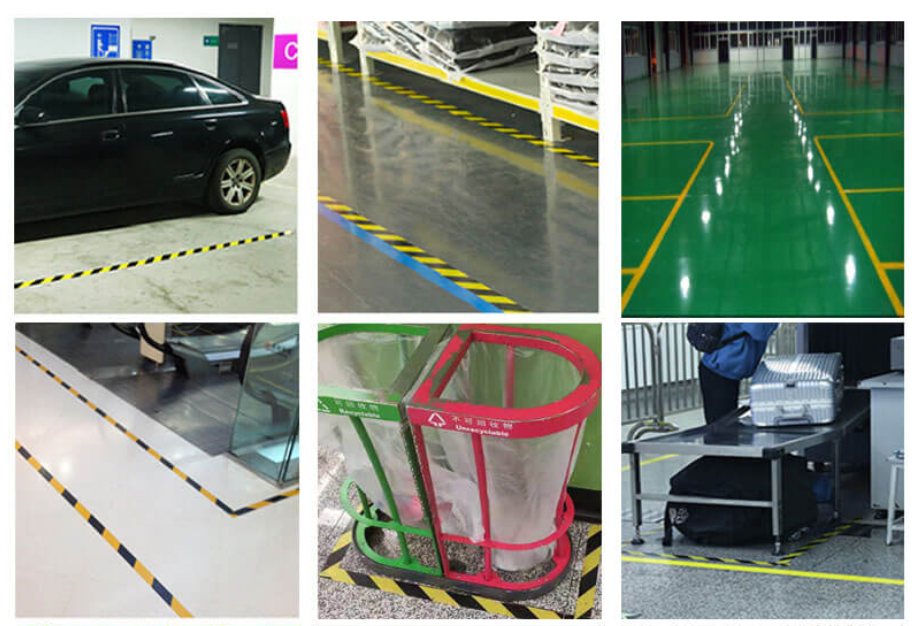
Above ground, warning tape is widely used in factory workshops, warehouses, logistics centers, parking facilities, shopping malls, sports venues, and public walkways. Typical functions include area separation, walkway marking, hazard identification, and 5S workplace organization.
For example:
- Yellow-and-black stripes can identify restricted equipment zones and potential hazard areas.
- Red-and-white stripes can mark restricted areas and certain fire safety boundaries.
- Green-and-white markings can help guide people along designated safe routes or toward emergency exits, where appropriate.
Every clearly defined line helps reduce ambiguity in the workplace and supports safer movement and operational management.
The global barricade and warning tape market was estimated at approximately USD 1.6 billion in 2025 and is projected to approach USD 2.2 billion by 2032, with an estimated compound annual growth rate of around 4.8%.
The driving force behind this growth is not necessarily that warning tape itself has become more technologically advanced. Rather, more organizations are recognizing a simple principle: the cost of an accident can far exceed the cost of establishing a clearly visible boundary.
Consistent Colors, Clear Boundaries: Manufacturing Reliability Is the Real Measure of Product Quality
Warning tapes may look very similar when displayed on a shelf. However, their condition after six months of actual use can reveal significant differences in manufacturing quality.
Backing thickness uniformity affects tensile performance. Adhesive formulation influences whether the tape remains securely bonded or begins to lift under temperature fluctuations and moisture exposure. The dispersion of color pigments affects color uniformity and may influence how well the tape retains its intended appearance during outdoor exposure.
These performance factors cannot be improved simply by applying more adhesive. They depend on systematic manufacturing controls, from raw material inspection and coating process management to finished-product testing.
This is the manufacturing philosophy behind Shanghai Newera Viscid Products Co., Ltd. (Newera) and its PVC Warning Tape product range.
With more than 30 years of adhesive tape manufacturing and export experience, Shanghai Newera supplies products to 80 countries and regions worldwide. PVC Warning Tape is one of its established product categories.
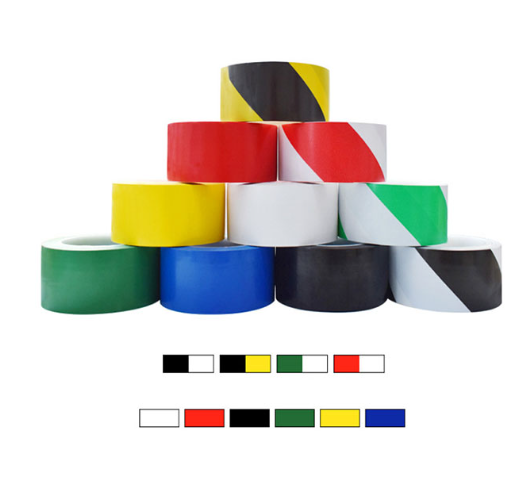
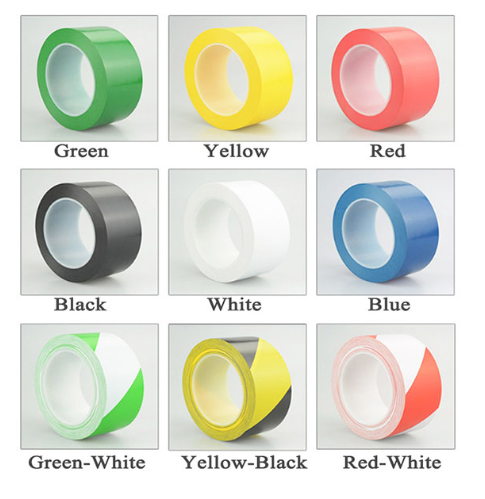
The product range covers thicknesses from 130 microns to 200 microns and supports both single-color options and two-color combinations, including yellow-and-black, red-and-white, green-and-white, and white-and-black. Customized widths, lengths, and printed identification are also available.
Supporting these specifications is a quality control process that includes professional laboratory testing of raw materials and finished products. The company’s stated compliance credentials include RoHS, SGS, ISO 9001, and REACH-related qualifications, subject to the scope of the applicable certificates and test reports.
The Shanghai manufacturing facility has a reported monthly production capacity of 3 million square meters and is equipped with precision imported machinery, including reaction kettles, coating machines, slitting machines, and rewinding machines.
These manufacturing resources help make color consistency and batch stability more controllable and repeatable, rather than leaving product quality to chance.
For buyers, the most important question when selecting warning tape should not simply be, “How much does one roll cost?” A more meaningful question is: “After one year of use, how many clearly visible boundaries will still remain?”
Faded warning tape does not simply disappear. It becomes a marking that people may gradually stop noticing or taking seriously.
Ultimately, the purpose of the manufacturer’s efforts—including laboratory testing, compliance documentation, production capacity, and quality control—is to ensure that the safety line remains where it is needed and continues to communicate its intended message throughout its service life.
From product development to bulk procurement, Shanghai Newera can provide corresponding OEM customization and product portfolio support based on customer requirements.
Post time: Nov-27-2026